Hockey is one of the most physically demanding sports in the world. Players must combine explosive speed, powerful skating, strength, endurance, agility, and mental toughness while performing at a high level for an entire game and throughout a long season.
A well-designed conditioning program is not simply about improving fitness. Effective hockey conditioning develops the specific physical qualities that directly impact performance on the ice, helping players skate faster, recover quicker, win battles, and reduce injury risk.
This guide explores everything hockey players need to know about conditioning, including energy systems, strength development, speed training, recovery strategies, and seasonal programming.
Why Conditioning Matters in Hockey
Unlike many endurance-based sports, hockey is characterized by repeated high-intensity efforts followed by short recovery periods.
A typical shift lasts between 30 and 60 seconds and involves:
- Explosive accelerations
- Rapid changes of direction
- Physical contact
- Shooting and puck battles
- High-speed skating
Players may perform dozens of these intense shifts during a game. The ability to repeatedly execute explosive actions without significant performance decline is what separates elite players from the competition.
Proper conditioning allows athletes to:
- Maintain skating speed late in games
- Recover faster between shifts
- Improve strength and power output
- Reduce fatigue-related mistakes
- Lower injury risk
- Increase overall performance consistency
Understanding Hockey’s Energy Systems
Successful conditioning starts with understanding how the body produces energy during competition.
ATP-PC System
This energy system powers short, explosive movements lasting up to 10 seconds.
Examples include:
- Sprinting to a loose puck
- Explosive starts
- Powerful body checks
- Quick shooting opportunities
Training methods include:
- Short sprints
- Plyometrics
- Explosive strength exercises
- Maximum-effort skating drills
Anaerobic Glycolytic System
This system dominates during longer high-intensity efforts lasting between 15 and 60 seconds.
Examples include:
- Extended offensive-zone pressure
- Long defensive shifts
- Repeated skating battles
Training methods include:
- High-intensity intervals
- Repeated sprint training
- Shift-length conditioning drills
Aerobic System
Although hockey is primarily anaerobic, the aerobic system plays a critical role in recovery.
It helps players:
- Recover between shifts
- Sustain energy throughout games
- Handle multiple games in tournaments
- Improve overall conditioning capacity
Training methods include:
- Aerobic intervals
- Tempo work
- Low-intensity cardio sessions
The best hockey players develop all three systems rather than focusing exclusively on endurance.
Strength Training for Hockey Players
Strength serves as the foundation of athletic performance.
Stronger players generally:
- Skate more powerfully
- Win more puck battles
- Absorb contact more effectively
- Produce greater force on every stride
Lower-Body Strength
The lower body drives skating performance.
Key exercises include:
- Squats
- Front squats
- Trap-bar deadlifts
- Romanian deadlifts
- Bulgarian split squats
- Lunges
These movements improve force production, acceleration, and overall skating power.
Upper-Body Strength
Upper-body strength is essential for puck protection, shooting, and physical play.
Effective exercises include:
- Pull-ups
- Chin-ups
- Bench press
- Dumbbell press variations
- Rows
- Landmine presses
The goal is balanced development rather than bodybuilding-style training.
Core Strength
The core transfers force between the upper and lower body.
Strong hockey players prioritize:
- Anti-rotation exercises
- Pallof presses
- Farmer carries
- Dead bugs
- Planks
- Cable rotations
A strong core improves balance, stability, and skating efficiency.
Developing Explosive Power
Strength alone is not enough. Players must be able to apply force quickly.
Power training bridges the gap between weight-room strength and on-ice performance.
Plyometric Training
Plyometrics improve explosive force production and skating acceleration.
Examples include:
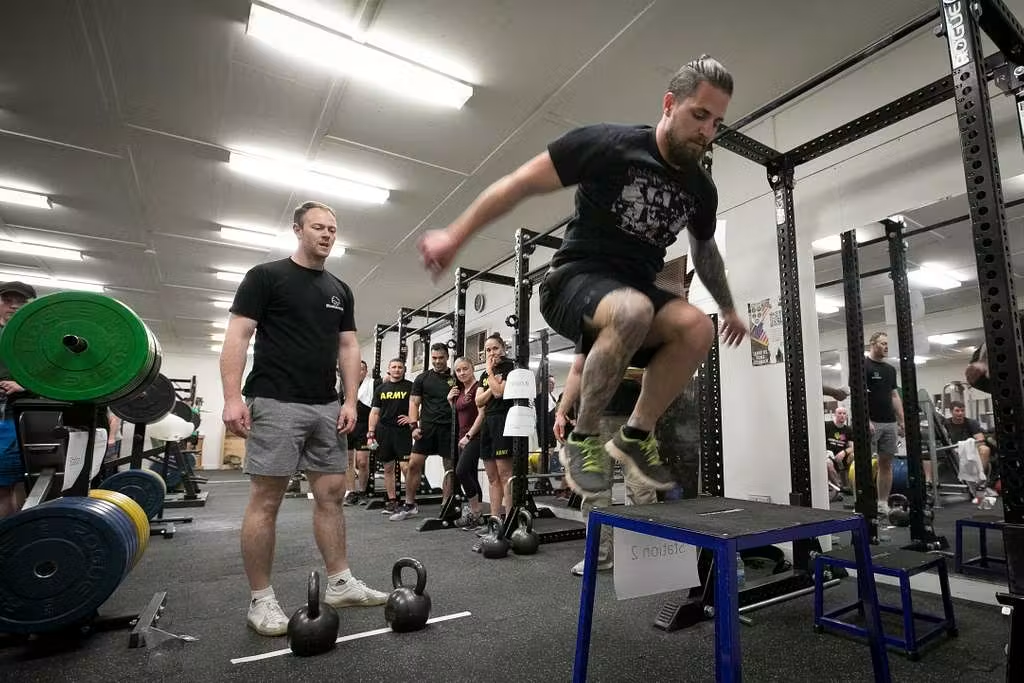
- Box jumps
- Broad jumps
- Lateral bounds
- Single-leg hops
- Depth jumps
Quality is more important than quantity. Every repetition should be explosive.
Olympic Lift Variations
Exercises such as:
- Power cleans
- Hang cleans
- High pulls
- Jump shrugs
teach athletes to generate force rapidly through the hips, a key component of skating performance.
Medicine Ball Training
Medicine ball exercises provide sport-specific power development.
Popular options include:
- Rotational throws
- Overhead slams
- Side tosses
- Scoop throws
These movements closely resemble the rotational demands of shooting and checking.
Speed and Agility Training
Hockey is a game of acceleration more than top-end speed.
Players rarely skate long enough to reach maximum velocity, making first-step quickness incredibly valuable.
Acceleration Development
Acceleration training should focus on:
- Short sprints
- Resisted sprints
- Hill sprints
- Explosive starts
Most sprint distances should stay under 20 meters.
Agility Training
Elite hockey players constantly react to changing situations.
Agility drills should include:
- Lateral movement
- Change-of-direction work
- Reaction drills
- Mirror drills
- Multi-directional sprint patterns
The objective is not simply moving quickly but changing direction efficiently under pressure.
Conditioning Methods for Hockey
High-Intensity Interval Training (HIIT)
HIIT closely replicates hockey’s demands.
Example:
- 30 seconds maximum effort
- 90 seconds recovery
- Repeat 8–12 times
This mirrors shift-to-rest ratios commonly experienced during games.
Repeated Sprint Training
Repeated sprint ability is a key predictor of hockey performance.
Example:
- 6-second sprint
- 20-second recovery
- Repeat 10–15 times
This develops both speed and recovery capacity.
On-Ice Conditioning
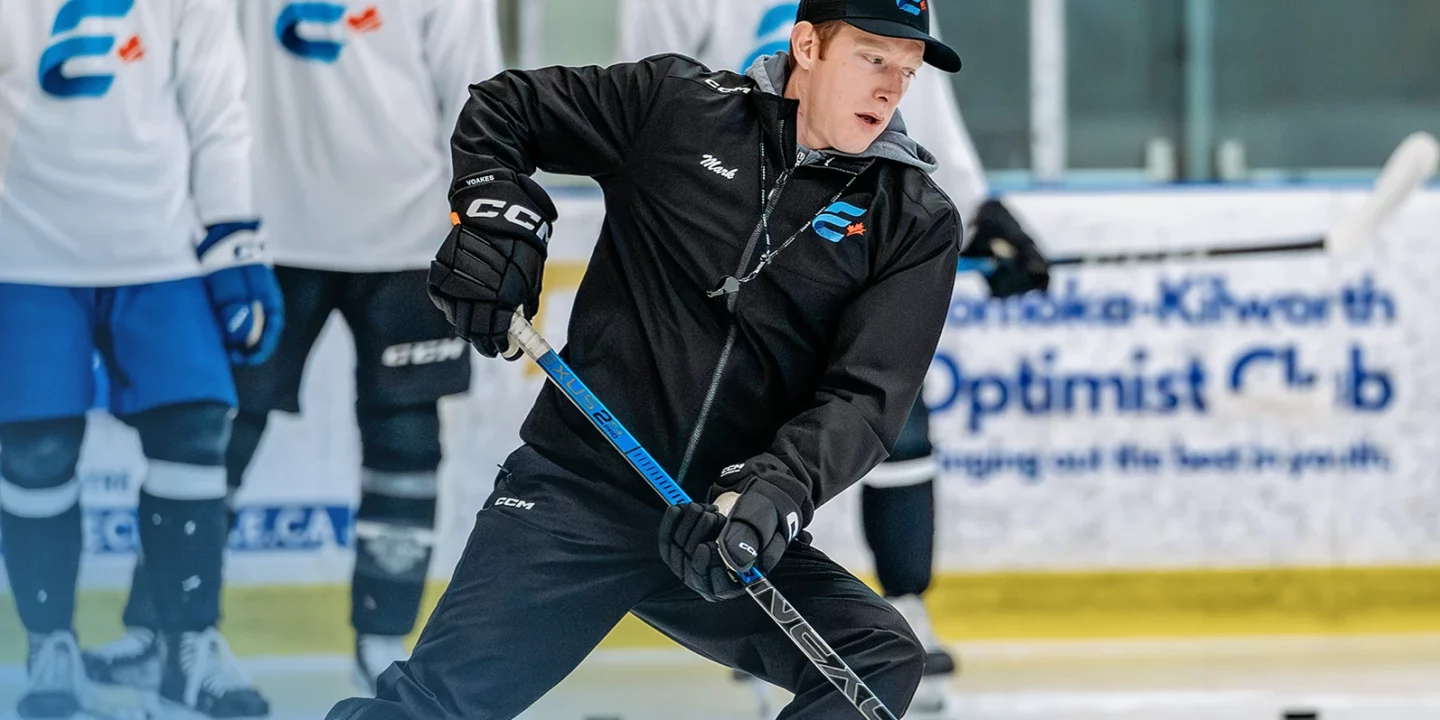
Whenever possible, conditioning should include skating.
Examples include:
- Full-ice sprint intervals
- Shuttle skating
- Overspeed drills
- Small-area competitive games
On-ice conditioning improves fitness while reinforcing hockey-specific movement patterns.
Mobility and Injury Prevention
Many hockey players develop:
- Tight hips
- Limited ankle mobility
- Restricted thoracic rotation
- Lower-back discomfort
A quality mobility program should address these issues regularly.
Essential Mobility Areas
Hip Mobility
Important for:
- Stride length
- Edge control
- Injury prevention
Exercises include:
- 90/90 stretches
- Hip flexor stretches
- Adductor mobility drills
Ankle Mobility
Improved ankle mobility supports skating mechanics and balance.
Exercises include:
- Ankle rocks
- Calf stretches
- Dorsiflexion drills
Thoracic Spine Mobility
Upper-body rotation influences:
- Shooting
- Passing
- Body positioning
Regular rotational mobility work can improve both performance and movement quality.
Recovery: The Most Overlooked Component
Conditioning improvements occur during recovery, not during training.
Sleep
Sleep remains the most effective recovery tool available.
Hockey players should aim for:
- 8–10 hours per night
- Consistent sleep schedules
- Limited screen exposure before bed
Nutrition
Performance nutrition should emphasize:
- Adequate protein intake
- Quality carbohydrates
- Healthy fats
- Proper hydration
Recovery meals should be consumed shortly after training sessions and games.
Active Recovery
Light activity promotes blood flow and recovery.
Examples include:
- Walking
- Cycling
- Swimming
- Mobility sessions
Recovery days should support adaptation without creating additional fatigue.
In-Season vs. Off-Season Conditioning
Off-Season
The off-season is the ideal time to:
- Build strength
- Increase muscle mass
- Improve aerobic capacity
- Address weaknesses
Training volume can be higher because competition demands are lower.
Pre-Season
The focus shifts toward:
- Hockey-specific conditioning
- Speed development
- Power production
- Game readiness
Training becomes more sport-specific as competition approaches.
In-Season
The goal changes from development to maintenance.
Priorities include:
- Managing fatigue
- Preserving strength
- Staying healthy
- Maintaining performance levels
Training volume decreases while intensity remains relatively high.
Mental Conditioning for Hockey Players
Physical preparation alone is not enough.
Elite players also develop mental skills such as:
- Focus
- Confidence
- Emotional control
- Resilience
- Competitive intensity
Mental conditioning techniques include:
- Visualization
- Breathing exercises
- Goal setting
- Performance routines
- Mindfulness training
The strongest athletes learn to perform consistently under pressure.
Common Conditioning Mistakes
Many hockey players waste valuable training time by making avoidable mistakes.
Too Much Long-Distance Running
While aerobic fitness matters, excessive long-distance running does not reflect the demands of hockey.
Training should prioritize intervals and explosive work.
Neglecting Strength Training
Speed and conditioning are limited without a foundation of strength.
Ignoring Recovery
More training is not always better. Recovery drives adaptation.
Training Without a Plan
Random workouts rarely produce consistent results.
Every conditioning program should have clear goals and progression.
Final Thoughts
Elite hockey conditioning is about much more than simply getting in shape. The best players develop a complete athletic profile that combines strength, power, speed, endurance, mobility, recovery, and mental toughness.
A successful hockey conditioning program prepares athletes to perform explosive actions repeatedly, recover quickly, and maintain a high level of performance from the opening faceoff to the final whistle.
Players who consistently invest in smart, hockey-specific conditioning not only improve their on-ice performance but also build the foundation for long-term success throughout their careers.