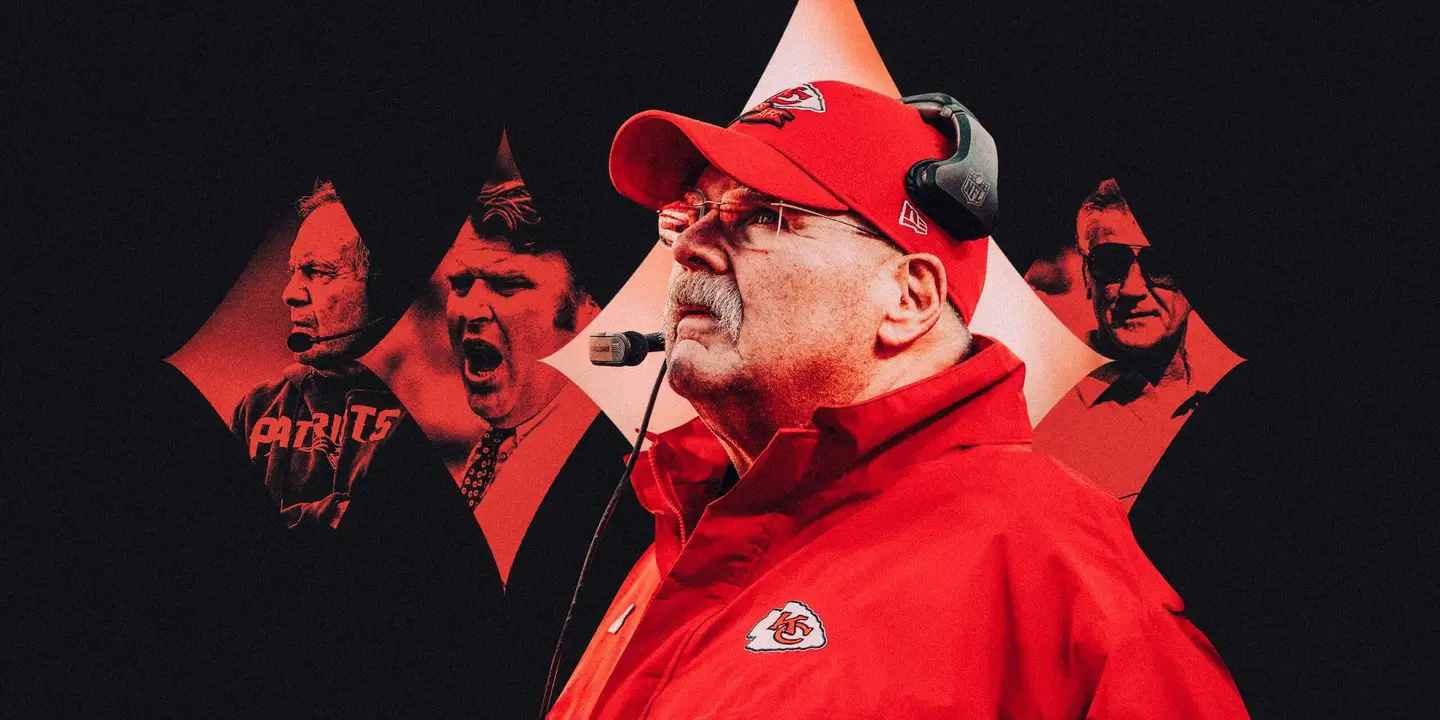
There is always a temptation in sports to declare the newest champion the greatest of all time. If the Kansas City Chiefs were to complete a historic three-peat, many would be ready to place Andy Reid at the very top of the NFL coaching hierarchy.
Coaches are often evaluated by how dominant they are during a particular era, and Reid’s current run certainly belongs among the most impressive in league history. A third consecutive Super Bowl title would make him the first coach to achieve that feat in the Super Bowl era, although legendary figures such as Curly Lambeau and Vince Lombardi captured three straight league championships long before the modern playoff format existed.
If championships alone determined greatness, however, Reid would still have ground to cover. He is pursuing his fourth Super Bowl title as a head coach. Bill Belichick owns six championships, while Lambeau and George Halas each won six before the Super Bowl era. Lombardi captured five NFL championships, including the first two Super Bowls. Reid is currently chasing the company of legends such as Chuck Noll and Guy Chamberlain.
The numbers are equally impressive in terms of career victories. Reid ranks fourth all-time, trailing only Don Shula, George Halas, and Bill Belichick.
Yet the most meaningful way to measure Reid’s greatness may not be through championships or wins. It may be through the qualities he shares with some of the greatest coaches football has ever seen. In Reid, you can find Belichick’s resilience, Shula’s ability to maximize talent, the quarterback expertise of Bill Walsh and Mike Holmgren, and the relatability that made John Madden so beloved.
The Belichick Connection
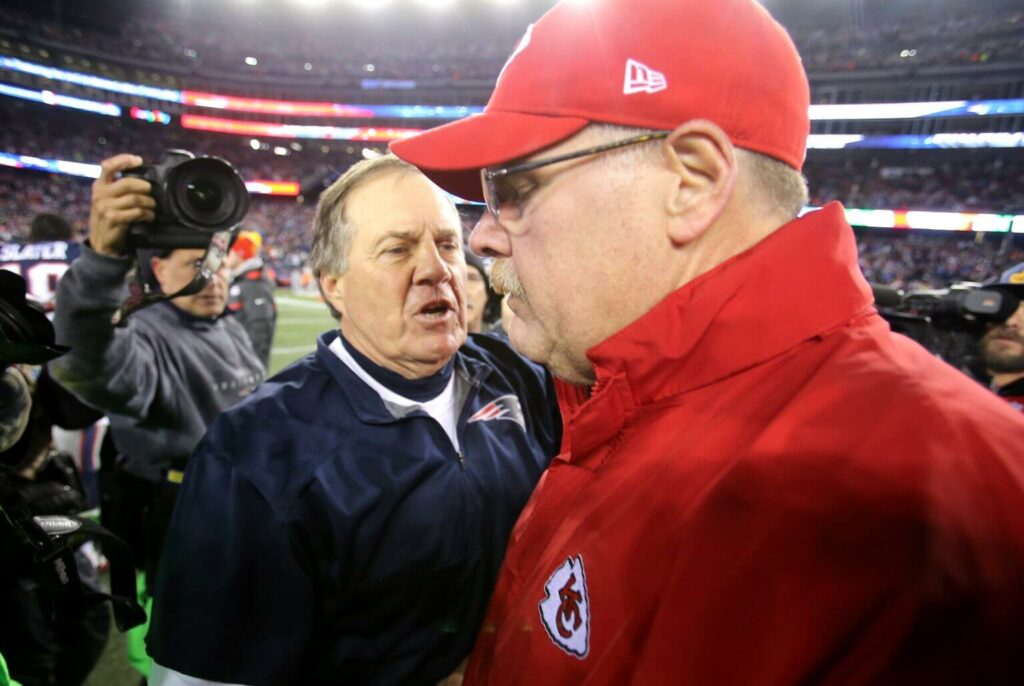
Reid has openly described Bill Belichick as one of the greatest coaches the sport has ever produced. Belichick, in turn, has repeatedly praised Reid as one of the NFL’s elite leaders. Their mutual respect stems from years of studying and competing against one another.
When it comes to postseason appearances, Reid has continued climbing the historical rankings. His consistency over decades places him among the most successful coaches ever to patrol an NFL sideline.
Although Belichick won the majority of their head-to-head meetings, including all three playoff matchups, the similarities between the two coaches are striking.
Neither man is easily rattled. Both maintain remarkable composure regardless of circumstances. Press conferences have never been their preferred arena; winning football games has always been the priority.
Preparation is another shared trait. Belichick became famous for identifying and exploiting opponents’ weaknesses, while Reid built a reputation for offensive innovation. His creative play design, especially in the red zone, consistently puts defenses in difficult positions.
Belichick once noted that Reid’s greatest strength is his ability to understand what his roster does best and build an offense around those strengths.
Perhaps the strongest parallel between the two lies in their durability and consistency. Belichick’s teams rarely endured losing seasons, and Reid’s record is even more impressive in that regard. Year after year, both coaches have found ways to remain competitive regardless of roster changes or external challenges.
Belichick navigated difficult moments throughout the Patriots dynasty without losing control of the organization. Reid, meanwhile, demonstrated extraordinary perseverance through personal tragedy. The death of his son Garrett in 2012 occurred during one of the most difficult periods of his coaching career.
After a disappointing season that ended his long tenure in Philadelphia, Reid quickly accepted the challenge of rebuilding the Kansas City Chiefs. Within one year, he transformed a two-win team into an eleven-win playoff contender.
Following the Path of Don Shula
Few coaches have managed to reinvent themselves successfully with a second franchise. Reid has done exactly that, drawing comparisons to Hall of Famer Don Shula.
Reid enjoyed considerable success with the Philadelphia Eagles, but his accomplishments with Kansas City have elevated his legacy even further. Like Shula, he proved that his success was not tied to a single organization.
Shula won an NFL championship with the Baltimore Colts before moving to Miami, where he built one of the greatest dynasties in football history, including the only perfect season the NFL has ever seen.
Reid’s appearance in multiple Super Bowls with different franchises reflects a similar ability to adapt, evolve, and sustain excellence.
A major reason both coaches achieved such success was their ability to maximize the people around them. Great coaches do not simply manage games; they build systems that allow players, assistants, and executives to thrive.
Both were demanding leaders, although their styles differed. Shula was known for his strict, hard-driving approach. Reid tends to lead with encouragement and positivity, while still maintaining high standards.
Their communication styles also share important similarities. Neither coach wastes words. Both are known for clear, direct messaging that leaves little room for confusion.
Another common factor is loyalty. Throughout his career, Reid has relied on a trusted inner circle of assistants and advisors.
Tom Melvin has worked alongside Reid for decades, dating back to their early coaching days. Special teams coordinator Dave Toub has spent much of his professional career under Reid’s leadership. Defensive coordinator Steve Spagnuolo, another longtime associate, eventually reunited with Reid in Kansas City after years apart.
The trust Reid places in these relationships mirrors the way Shula surrounded himself with familiar voices throughout his coaching career.
The same loyalty extends beyond the coaching staff. Chiefs General Manager Brett Veach began working with Reid more than two decades ago. Sports medicine executive Rick Burkholder has been alongside Reid for the entirety of his head-coaching journey. Longtime agent Bob LaMonte has served as both advisor and confidant.
Like Shula before him, Reid understands the value of continuity.
The Walsh-Holmgren Quarterback Legacy
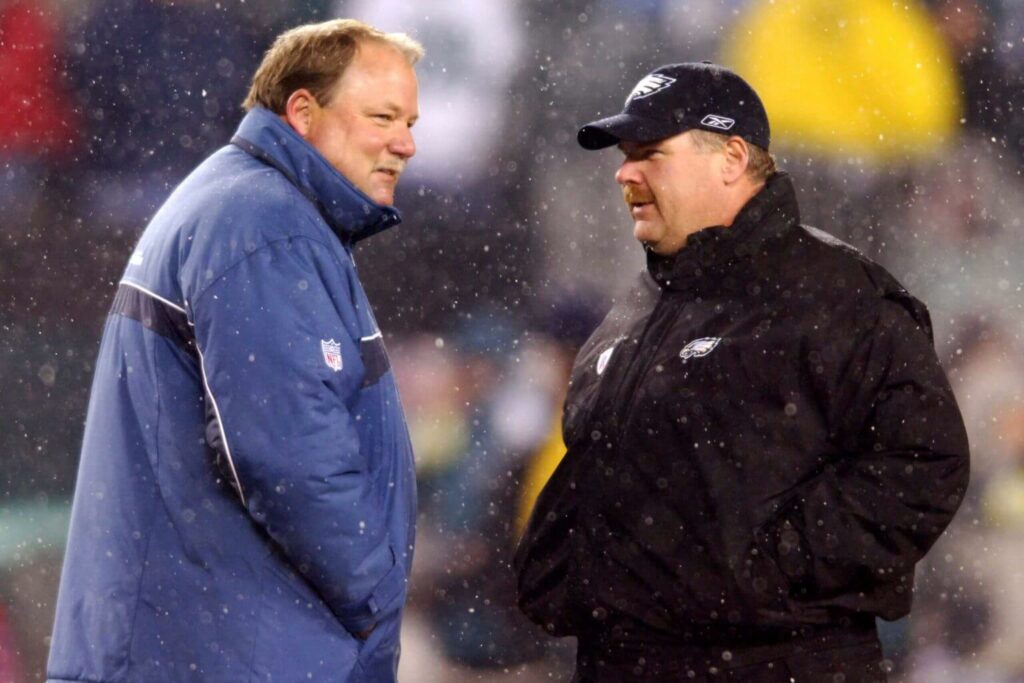
A direct coaching lineage connects Bill Walsh, Mike Holmgren, and Andy Reid.
Walsh revolutionized offensive football and won three Super Bowls with the San Francisco 49ers. Holmgren carried those ideas forward, revitalizing multiple franchises and developing elite quarterbacks. Reid has continued that tradition while creating his own legacy.
One of the defining characteristics shared by all three coaches is their extraordinary ability to identify, develop, and elevate quarterbacks.
Walsh helped transform Joe Montana and Steve Young into legends while also influencing the careers of players such as Ken Anderson and Dan Fouts.
Holmgren resurrected Brett Favre’s career and developed several future starting quarterbacks, including Mark Brunell, Matt Hasselbeck, and Aaron Brooks.
Reid’s track record is equally remarkable.
His first major move in Philadelphia was selecting Donovan McNabb, who became one of the NFL’s most successful quarterbacks of his era. When McNabb suffered a season-ending injury, Reid guided Jeff Garcia to unexpected success and a playoff appearance.
Later, Reid helped Michael Vick revive his career after years away from football. Under Reid’s guidance, Vick produced arguably the finest season of his professional career.
Nick Foles also developed under Reid before eventually returning to Philadelphia and helping the Eagles win a Super Bowl.
When Reid arrived in Kansas City, he inherited Alex Smith, a quarterback many considered a disappointment after years of inconsistency. Reid helped Smith reach the most productive stretch of his career.
Then came Patrick Mahomes.
Recognizing Mahomes’ unique potential, Reid and Brett Veach aggressively moved up in the draft to select him. Reid provided the environment, support, and freedom necessary for Mahomes to become one of the most dynamic quarterbacks the game has ever seen.
The Chiefs’ transformation under Reid speaks for itself. After years of inconsistency, Kansas City became one of the NFL’s model franchises.
Like Walsh and Holmgren before him, Reid has repeatedly demonstrated an ability to rebuild struggling organizations and turn them into perennial contenders.
Building Coaching Trees and Making Difficult Decisions
Another hallmark shared by Walsh, Holmgren, and Reid is the ability to identify coaching talent.
Throughout his career, Reid has mentored and developed an impressive list of future head coaches and coordinators, including Doug Pederson, Sean McDermott, Ron Rivera, Todd Bowles, John Harbaugh, Leslie Frazier, Matt Nagy, and many others.
Great coaches do not simply build teams. They build future leaders.
Reid has also shown a willingness to make difficult decisions when necessary.
Moving on from Donovan McNabb was controversial. Transitioning from Alex Smith to Patrick Mahomes carried significant risk. Yet Reid consistently demonstrates an ability to prioritize long-term success over short-term comfort.
That willingness to act decisively is another trait shared with football’s coaching legends.
The John Madden Influence
Excellence and relatability do not always coexist, but Reid manages to embody both.
In this respect, he resembles John Madden.
Both were former offensive linemen who never tried to hide their larger-than-life personalities. Both used humor and self-awareness to connect with players and fans alike.
Reid has become famous for joking about cheeseburgers, appearing in commercials, celebrating victories with playful enthusiasm, and never taking himself too seriously.
Behind that humor, however, lies one of his greatest strengths: genuine human connection.
Reid remembers names. He remembers families. He takes the time to know the people around him.
Patrick Mahomes has often spoken about Reid’s ability to relate to players from every possible background. Whether someone grew up wealthy or faced difficult circumstances, Reid understands how to communicate with them and bring out their best.
His coaching philosophy emphasizes acceptance rather than judgment. Reid encourages players to be authentic while providing them opportunities to grow.
That approach helped players such as Michael Vick, Tyreek Hill, Marcus Peters, and Travis Kelce maximize their potential despite facing various challenges throughout their careers.
John Madden was known for managing strong personalities and creating successful teams by understanding people. Reid has done much the same.
Madden served as a mentor to Reid for many years. Their relationship extended far beyond football, and Reid often credited Madden for teaching him how to appreciate every aspect of the profession.
When Madden passed away, Reid spoke about how much the legendary coach had influenced his life and career.
People listened to Madden because they respected him.
People listen to Reid for the same reason.
His ability to connect, lead, innovate, and consistently win is why he belongs among football’s all-time great coaches.
And regardless of where he ultimately ranks in the historical debate, Andy Reid has already earned a place alongside the legends whose examples helped shape his remarkable career.